Historic California
Posts, Camps, Stations and Airfields
Minter Field
(Shafter Gap Filler
Annex P-59A, Shafter Army Aviation Test Activity)
History
by Richard E. Osbourne
Minter Field was originally constructed
under the Defense Landing Area Program for the U.S. Army as a
flight training center
near the town of Shafter, 13.5 miles northwest of Bakersfield.
Although officially dedicated on Saturday,
February 7, 1942, operations on Minter Field actually began in
June of 1941 when the post was garrisoned by only a small guard
unit. The base commander, Colonel Carl Pyle, established his
headquarters on the Bakersfield Junior College campus in the
city while base personnel camped out in temporary quarters scattered
from Bakersfield to Wasco, located some fifteen miles to the
northwest of Minter Field.
Minter Fields was a city within itself
having served the 7,000 personnel stationed at the airfield during
World War II for training, living and recreational needs. Although
many of the facilities have been removed over the years, there
was a chapel, swimming pool, theater, post office, and infirmary,
among just a few of the services that were provided for those
stationed here. The remaining buildings are now used as offices
or warehouses including the Airport Administration Office.
By early August, 1941, multiple units
began moving onto the field as construction of wooden buildings
accelerated. In the beginning, the airport was known as Lerdo
Field because of its close proximity to the highway of the same
name. In October of 1941, the Minter Sub-Depot was established
as a branch of the Sacramento Air Depot. There was a prisoner of war camp here that held
about 600 prisoners of war.
The field was named in honor of First Lieutenant Hugh C. Minter,
a member of the locally prominent Minter family. The Lieutenant,
a World War I veteran, was killed in a mid-air collision over
March Field in July, 1932.
In April of 1942, contracts for the construction of more than
65 on-base buildings were let while the constantly increasing
numbers of cadets were housed in a large tent city erected as
temporary shelter. By July of 1942, Minter Field had become the
largest training base of its type on the West Coast, with nine
auxiliary landing fields located in:
During the course of the War, more than
11,000 Army Air Corps Cadets graduated from Minter Field, deploying
around the world to fly in all theaters of operations.
For a while it was
known as Bakersfield Air Corps Flying School and offered pre-flight
and basic flight training. Late in the war Chinese pilots trained
here. The principle training aircraft
was the Consolidated Vultee Valiant, affectionately known as
the "Vultee Vibrator", powered by a 450 HP Pratt &
Whitney Wasp R985 nine-cylinder radial. The aircraft had fixed
gear and Hamilton-Standard two speed props. Other training aircraft
included the Cessna UC-78 Bobcat, also known as the "Bamboo
Bomber" because of its extensive use of lightweight wood
in the fuselage and wings. The Cessna was a twin-engine "Light
Personnel Transport" and advanced trainer. Aircraft also
seen on the field during World War II included the AT-6 Texan
trainer, B-25 Mitchell twin-engine bomber, and P-38 Lightning,
as well as other widely used fighter, bomber and observation
craft.
Upon the close of the war, the airfield
was turned over to the County of Kern which managed the airport
until 1985. In 1985 the Minter Field Airport District was formed
by tenants and local citizens interested in aviation to take
over the ownership and operation of the Airport from the County.
Source: World War II Sites
in the United States: A Tour Guide and Directory by Richard E.
Osbourne
Minter Field
By Justin M. Ruhge, Goleta Valley Historical
Society
Named in honor of Hugh C. Minter, killed
in an airplane collision on March Field on July 8, 1932. He was
a World War I veteran and Commander of the 73`d Pursuit Squadron
at March Field when his plane crashed in mid-air with another
aircraft. In 1918 he joined the Army Air Corps after a year of
study at Redlands University.
Minter Army Air Field was officially dedicated
on February 7, 1942. Operations began in June 1941. By early August
1941, multiple units began arriving on the field as construction
of wooden buildings accelerated. In the beginning the airport
was known as Lerdo Field because of its close proximity to the
highway of the same name. In October of 1941, the Minter sub-Depot
was established as a branch of the Sacramento Air Depot. The Field
Commander was Colonel Carl Pyle.
In April of 1942, contracts for the construction
of more than 65 on-base buildings were let while the constantly
increasing number of cadets was housed in a large tent city erected
as temporary shelter.
By July 1942, Minter Field had become the
largest training base of its type on the west coast with nine
auxiliary landing fields. Auxiliary fields: Wasco Auxiliary Field
Al, Famosa Auxiliary Field A3, Dunlap Auxiliary Field A4, Semi-tropic
Auxiliary Field A5, Poso Auxiliary Field A6, Lost Hills Auxiliary
Field A8.
The training aircraft were Vultee BT-13s
and UC-78s.
During the course of the War, more that
11,000 Army Air Corps Cadets graduated from Minter Field, deploying
around the world to fly in all theaters of operations.
The field, in 2005, is still active in general aviation.
Reference: A Brief History
of Minter Army Air Field, Shafter California, by the Minter-Field
Air Museum, 1996.
Known Units
Stationed at Minter Field
1 June 1943
Army Station List
Army Air Forces:
Army Air Forces Basic Flying
School
Aviation Cadet Detachment
Army Air ForcesWeather Station
(Type B)
Finance Detachment
Medical Detachment (Colored)
Veterinary Detachment
Detachment, 1st Weather Squadron,
Regional
7th Sub-Depot
23rd Aviation Squadron (Colored)
Detachment, 39th Air Freight
Wing
64th Base Headquarters and Air
Base Squadron
324th Basic Flying Training
Squadron
326th Basic Flying Training
Squadron
327th Basic Flying Training
Squadron
407th Aviation Squadron
525th Basic Flying Training
Squadron
526th Basic Flying Training
Squadron
739th Basic Flying Training
Squadron
740th Basic Flying Training
Squadron
Detachment 6, 858th Signal Service
Company, Aviation
872nd Guard Squadron
Detachment 7, 909th Quartermaster
Service Company, Aviation
974th Quartermaster Truck Platoon,
Air Base (Colored)
Detachment 4, 2063rd Ordnance
Service Company, Aviation
7 April
1945 Army Station List
Army Air Forces:
Army Air Forces Pilot School
(Basic)
Third Echelon Repair Shop
35th Flying Training Wing
Headquarters and Headquarters
Squadron
Section, 68th Army Air Forces
Base Unit (1st Weather Region)
Detachment, Section D, 85th
Army Air Forces Base Unit (101st Army
Airways Communications Service
Squadron)
543rd Army Air Forces Band
3001st Army Air Force Base Unit
(Headquarters 35th Flying Training Wing)
3008th Army Air Forces Base
Unit (Pilot School, Basic)
Women's Army Corps Squadron
7 May 1946
Army Station List
Army Air Forces:
35th Flying Training Wing
Headquarters and Headquarters
Squadron
543rd Army Air Forces Band
Detachment, 731st Army Air Forces
Base Unit (101st Airways
Communications Service Squadron)
Extract,
January 1945 US Army Air Forces Directory of Airfields
Extract,
War Department Inventory of Owned, Sponsored and Leased Facilities,
1945
Capacity:
Enlisted:
Permanent:
Mobilization:3,593
Theater of Operations: 442
Hutments:
Tents:
Total: 4,035
Officers: 336
Station Hospital: 169
Acreage
Owned: 1,467
acres
Leases:
Total:
1,467 acres
Storage:
Covered:
Open:
Cost to Government Since 1 July 1940:
Annual lease payments:
Land:
$111,000.00
Construction: $5,519,533.00
Total (less annual leases): $5,630,533
Remarks:
Shafter Gap
Filler Annex
"During the late 1950s another area
of progress was the development and deployment of AN/FPS-14 and
AN/FPS-18 gap-filler radars. Having a range of around sixty-five
miles, these radars were placed in areas where it was thought
enemy aircraft could fly low to avoid detection by the longer-range
radars of the permanent and mobile radar networks. Gap-filler
radar deployment peaked in December 1960 at 131 sites throughout
the continental United States. Because the introduction of gap-filler
radars alleviated the need for civilians to scan the skies for
enemy bombers, the ADC disestablished the Ground Observer Corps
on January 31, 1959."
Searching The Skies
USAF Air Combat Command
June, 1997
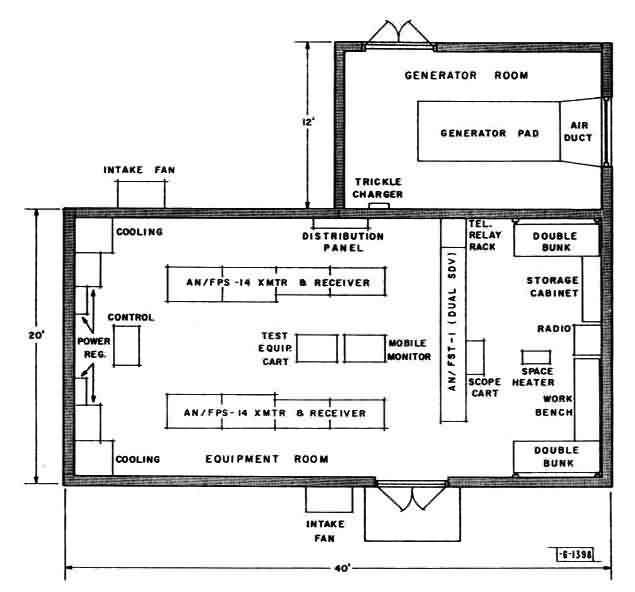
Typical floorplan
of a Gap Filler Annex
As the Cold War progressed, Minter Field
again answered the call, But this time as the site for early
warning radar. In late 1950 this Lashup site was operating an
AN/CPS-4 radar. In June 1952 Mt. Laguna AFS (P-76) assumed coverage
for this area. A planned long-range AC&W radar site at this
location (Shafter AFS, designated SM-161) was never built; instead,
gap-filler radar site P-59A was activated here, as well as remote
GATR (Ground-to-Air Transmit and Receive) site R-10.
Shafter Army
Aviation Test Activity
US Army Corps of Engineers
Los Angeles District History (1992)
On 1 April 1968, the Department of Defense
acquired 1.16 acres from the County of Kern through Lease No.
DACA09-5-69-393. This included Parcel No. 1 of Tract 100 which
contained 0.237 acres of land underlying Building T-58, and Parcel
No. 2 which contained 0.918 acres of land adjoining Building
T-58 to the northwest.
The subject property was used by Edwards Air Force Base, Army
Aviation Test Activity, for performance testing of new aircraft
to determine take-off, landing, and hovering data. A women's
restroom and a 30,000-pound helicopter tiedown may have been
constructed.
On 10 May 1973, Lease No. DACA09-5-69;393 with the County of
Kern was terminated releasing 1.16 acres. Presently the property
is owned by the Minter Field Airport District which uses the
remaining concrete foundation of Building T-58 and adjoining
property to the northwest for the storage of portable aircraft
hangars.
Undated US Army Corps of
Engineers Los Angeles District History
On 5 December 1942, the united states
of America acquired Minter Field (Shafter Airport) by Eminent
Domain in a Declaration of Taking from the County of Kern for
the establishment of an Army Air Corps training center. In 1949
the airport was returned to the County of Kern by Quitclaim Deed,
with recapture clause. It was during this period of military
use that Building T-58 was constructed on the subject site.
On 1 April 1969, the Department of Defense acquired 1.l6 acres,
including Building T-58, by lease from the County of Kern for
the Shafter Aviation Test Activity site. Edwards Air Force Base,
Army Aviation Test Activity, used the property for aircraft performance
testing until the lease was terminated on 10 May 1973. A women's
restroom and a 30,000-pound helicopter tiedown
may have been constructed.
Currently the property is owned by the Minter Field Airport District.
Building T-58 burned down in June 1988 leaving the foundation
and associated subsurface structures. The foundation and adjoining
property to the northwest are used for the storage of portable
aircraft hangars.